



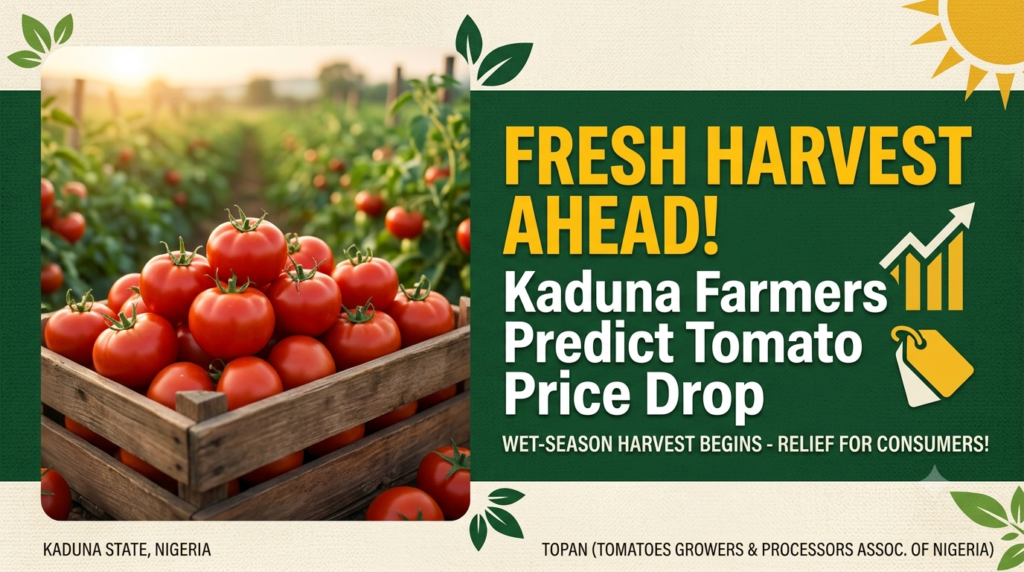
Relief in Sight: Tomato Prices Expected to Drop by August, Say Kaduna Farmers
Relief is on the horizon for Nigerian households grappling with skyrocketing food costs. The Tomatoes Growers and Processors Association of Nigeria (TOPAN) has assured consumers that the current high prices of tomatoes are expected to decline considerably starting in August, driven by the arrival of the wet-season harvest.
The Kaduna State Chairman of TOPAN, Mr. Rabiu Zuntu, explained that the recent price surge—which began in early May—is a seasonal trend. The spike followed the conclusion of the dry-season harvest, leading to a temporary reduction in market supply. The financial impact on consumers has been severe. In January, a 50kg basket of tomatoes sold for between ₦18,000 and ₦20,000. Recently, that same basket has commanded between ₦100,000 and ₦130,000 depending on the variety, while 25kg crates at wholesale hubs like Lagos have jumped to between ₦50,000 and ₦70,000.
> “We projected that the increase in tomato prices would last until the end of July, when wet-season harvesting begins,” Zuntu stated. “From August, prices will begin to decline considerably because fresh supplies will enter the market.”
A pivotal factor mitigating a longer shortage this year is the proactive adoption of agricultural technology. Zuntu highlighted that many farmers have shifted to using improved, flood-resistant tomato varieties. This climate-smart adaptation has allowed cultivation to continue successfully through the heavy rainy season. Without these resilient seed varieties, farmers warn that the market supply would have remained choked, forcing Nigerians to wait until October or November for any noticeable financial reprieve.
The recurring scarcity seen between May and June is heavily tied to climate change. Unpredictable rainfall patterns and extreme heatwaves in major northern producing states, such as Kaduna and Kano, have traditionally limited the windows for open-field tomato cultivation. Moving forward, TOPAN emphasizes that making heat-tolerant and disease-resistant seed varieties widely available to smallholder farmers will be critical to permanently smoothing out these annual price spikes.
For now, agricultural stakeholders are urging the public to exercise patience through July. As the wet-season harvests prepare to move from the fields of Kaduna to markets nationwide, a welcome stabilization of kitchen budgets is just weeks away.